
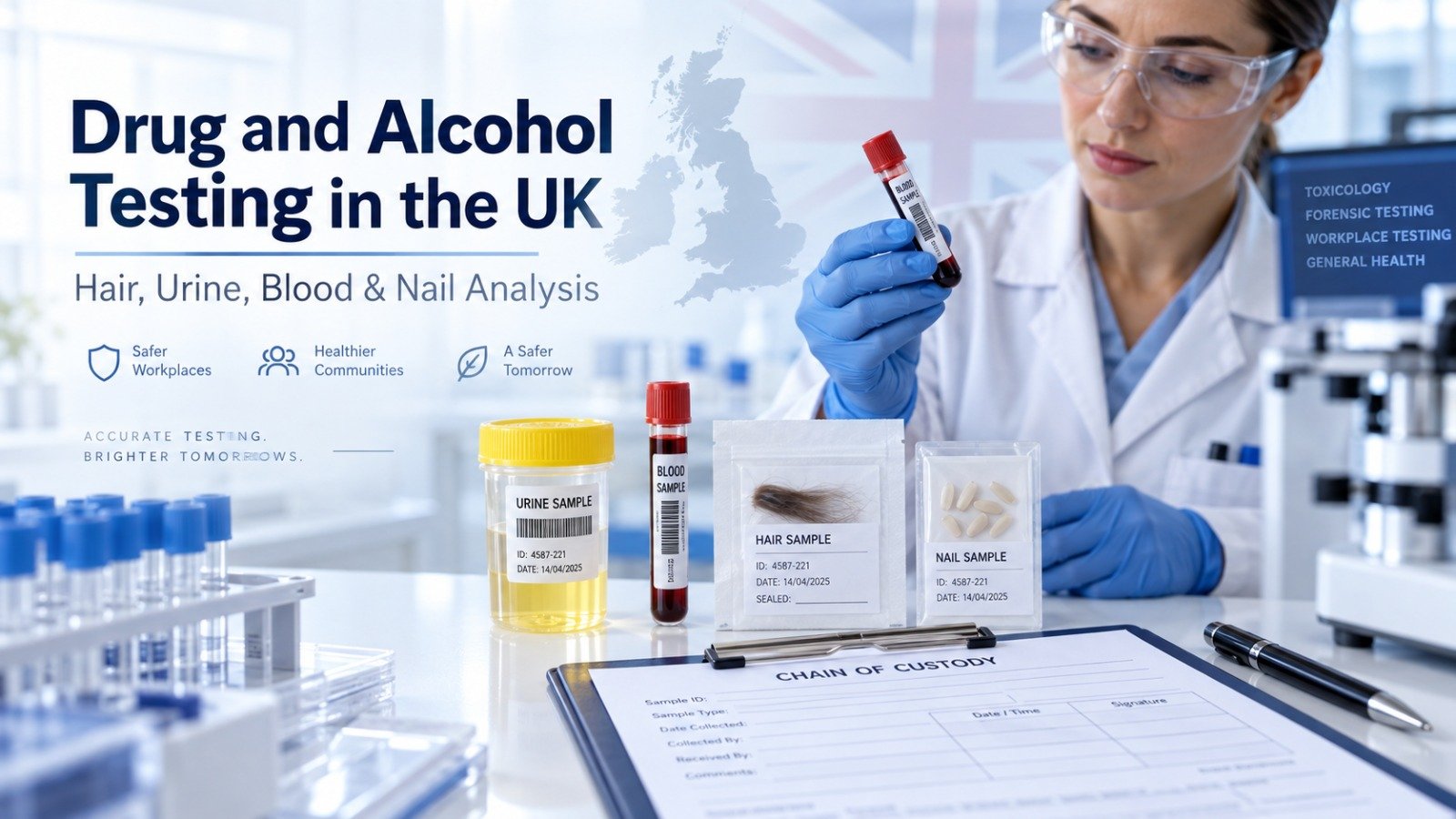
Drug and alcohol testing in the UK is used in circumstances ranging from family law and safeguarding cases to workplace safety, private testing and court proceedings. Yet the purpose of a test can vary considerably. An employer concerned about a safety-critical role may require very different information from a solicitor dealing with a family law matter, while an individual arranging a private test may simply want reliable evidence concerning recent or historical substance use.
That difference matters because no single test can answer every question. Hair, nail, blood and urine samples each provide different types of information and cover different detection periods. The reliability of the result also depends on appropriate sample collection, laboratory analysis, chain-of-custody procedures and professional interpretation.
For people or organisations looking for drug and alcohol testing services, understanding these differences before arranging a test can help ensure that the method selected is appropriate for the circumstances rather than simply convenient.
Why Drug and Alcohol Testing Is Used Across the UK
Drug and alcohol testing is not restricted to criminal investigations. In Britain, it can form part of civil and family proceedings, workplace policies, safeguarding assessments and private enquiries.
A family solicitor, for example, may need evidence relating to an individual’s pattern of substance use over several months. A local authority safeguarding team may need scientifically supported information to assist with an assessment involving a child or vulnerable person. An employer may be more concerned about whether recent drug or alcohol use could create a health and safety risk.
Private individuals may also arrange testing for reassurance or to provide evidence requested by another organisation.
This means the starting point should normally be the question that needs answering.
Is the concern about something that may have happened during the past few days? Is a longer history required? Does the result need to be suitable for formal legal proceedings? Is repeated testing likely to be required?
Once the purpose and timeframe are clear, an appropriate sample type can be selected.
Workplace Testing Has Particular UK Requirements
Workplace drug and alcohol testing is one area where UK-specific rules and good practice are particularly important.
Employers cannot simply introduce arbitrary testing because they suspect that an employee may have used drugs. According to current GOV.UK guidance on drug testing at work, employers need consent to test employees for drugs. Testing will normally form part of a contractual health and safety policy set out in an employment contract or staff handbook.
Government guidance also states that employers should limit testing to employees who genuinely need to be tested and should not unfairly single out particular individuals unless the nature of their work provides justification.
These considerations can be particularly relevant in safety-critical roles.
Someone operating heavy machinery, driving professionally, working around hazardous equipment or making decisions affecting the safety of others may present a significantly greater risk if impaired than someone performing a role without comparable safety responsibilities.
The Health and Safety Executive takes a similarly structured approach.
Its current guidance on screening and testing for drugs and alcohol explains that screening can have a place in certain workplaces, particularly where employees make safety-critical decisions. However, the HSE emphasises that testing should form part of a wider health and safety policy rather than being viewed as a solution by itself.
This distinction is important. Testing can provide evidence, but an effective workplace policy should also address prevention, management, employee support, confidentiality and what happens when a problem is identified.
Family Law and Safeguarding Require a Different Approach
The priorities can be very different in family law.
Where drug or alcohol use has become relevant to child arrangements, parental responsibility or safeguarding concerns, the important question may not simply be whether a substance has been used recently.
Solicitors, barristers, local authorities or the courts may need a broader picture.
For example, they may need to understand whether results indicate a historical pattern of substance use, whether the evidence is consistent with abstinence during a particular period, or whether recent testing supports or contradicts other information available in the case.
In these situations, the choice of sample can have a substantial effect on the usefulness of the evidence.
Hair testing may provide historical information over a period of months. Nail testing can offer another longer-term option where appropriate. Blood testing, including PEth testing for alcohol, can address a shorter and more recent period, while urine testing is commonly used where recent consumption is the main concern.
Sometimes a combination of methods is more useful than relying on a single sample.
The purpose is not simply to generate a positive or negative result. It is to obtain scientifically meaningful information that corresponds with the period and question being considered.
Hair Strand Testing for a Longer-Term Picture
Hair strand testing is particularly useful when historical patterns need to be examined.
As hair grows, certain drugs and their metabolites can become incorporated into the hair. Analysis can therefore provide information relating to substance use during the period represented by the sample.
One of the advantages of scalp hair is that, where suitable length is available, it may sometimes be divided into sections. This allows different periods to be considered separately rather than treating the entire sample as representing one undifferentiated timeframe.
That can be particularly relevant in family proceedings.
For example, where someone states that their substance use changed several months previously, testing covering different time periods may help provide objective evidence that can be considered alongside other information.
However, hair testing is not an exact diary of every occasion on which a substance was consumed. Results require appropriate interpretation, and factors such as sample length, the substance involved and the testing methodology need to be considered.
This is why the quality of the laboratory and the reporting process matter as much as collection of the sample itself.
Nail Testing When Hair Is Not Suitable
Hair is not suitable in every case.
Some people have very short scalp hair, may have insufficient hair for the required analysis or may have other circumstances that make hair collection impractical.
Nail testing provides another option.
Fingernail or toenail samples can be analysed for evidence of drug or alcohol exposure over a longer period. Because nails grow differently from scalp hair, nail results are not interpreted in exactly the same way as segmented hair testing.
Nevertheless, nail analysis can be useful where longer-term information is required and an appropriate hair sample cannot be obtained.
It may also be considered alongside other sample types when professionals need evidence covering different periods.
Blood Testing and PEth for Alcohol
Alcohol testing presents its own challenges because different biomarkers can answer different questions.
One increasingly established method is phosphatidylethanol, usually shortened to PEth, which is measured in blood and is associated with alcohol consumption.
PEth testing is particularly relevant where information about alcohol consumption during a comparatively recent period is required.
This can make it useful in legal, safeguarding and private cases where the issue is not necessarily what happened many months ago, but whether there is evidence of alcohol consumption within a more recent timeframe.
The interpretation of any alcohol test should still be based on the analytical findings and the circumstances of the case rather than assuming that one laboratory number tells the entire story.
Urine Testing for Recent Use
Urine testing generally addresses a much shorter period than hair or nail testing.
After a drug is consumed and processed by the body, the drug itself or its metabolites may be detectable in urine for a period of time. The actual detection window varies according to the substance, frequency of use, individual metabolism and other factors.
This makes urine testing particularly useful when recent rather than historical substance use is being investigated.
It can be relevant in workplace situations, legal instructions, safeguarding matters and other circumstances where an immediate or relatively recent picture is required.
However, a negative urine result should not automatically be interpreted as evidence that a person has never used a substance. It relates to the detection window of the test.
This illustrates why matching the sample to the question is so important.
Why Chain of Custody Matters
When test results may be used in court or another formal setting, laboratory accuracy is only part of the evidential picture.
There must also be confidence that the sample analysed by the laboratory genuinely came from the individual concerned and was protected appropriately between collection and testing.
This is the purpose of chain-of-custody procedures.
A properly controlled collection process may include identity verification, documentation of the sample, secure packaging, appropriate labelling and records showing how the sample has moved from the collection stage to laboratory analysis.
It creates traceability.
Without adequate procedures, questions may arise about contamination, substitution, misidentification or handling of the sample.
This is especially significant where the findings could contribute to important decisions concerning children, employment, legal proceedings or safeguarding.
Individuals requiring drug and alcohol testing services for a formal purpose should therefore consider not only which substances can be tested but also how samples are collected, documented, analysed and reported.
What UKAS Accreditation Actually Means
The term “accredited laboratory” is frequently used when discussing forensic and analytical testing, but it is useful to understand what accreditation represents.
The United Kingdom Accreditation Service, or UKAS, is the UK’s national accreditation body.
For testing laboratories, an important standard is ISO/IEC 17025:2017.
According to current UKAS guidance on ISO/IEC 17025 laboratory accreditation, technical competence involves factors including staff qualifications and experience, appropriate equipment, quality-assurance procedures, suitable sampling practices, valid test methods, accurate recording and appropriate reporting procedures.
In practical terms, accreditation provides an independent framework for assessing whether a laboratory is competent to undertake specified testing activities.
There is also an important detail that can sometimes be overlooked: accreditation relates to a defined scope of activity. When testing carries significant legal or evidential weight, it is therefore sensible to understand not simply whether accreditation exists, but whether the relevant analytical work falls within an appropriate accredited scope.
Choosing the Test According to the Detection Window
A useful way of thinking about drug and alcohol testing is to start with time.
If the question concerns the last few days, a short-term method such as urine testing may be appropriate.
If the objective is to examine substance use over a longer period, hair or nail testing may be more informative.
Where recent alcohol consumption needs to be investigated, PEth blood testing may be considered.
The broad principle is straightforward:
Recent question = shorter detection window
Historical question = longer detection window
The reality is more nuanced because different substances behave differently and every sample type has limitations. Nevertheless, defining the required period before arranging testing can prevent a situation where scientifically accurate results fail to answer the actual question being asked.
Testing Should Be Proportionate to the Situation
More testing is not automatically better testing.
A large screening panel may make sense in one situation but be unnecessary in another. Similarly, requesting several sample types without a clear reason may create additional cost without materially improving the evidence.
A better approach is to consider:
- the substances of concern;
- the period that needs to be investigated;
- whether recent or historical use is relevant;
- whether results are required for court or safeguarding purposes;
- whether repeat testing will be needed;
- what sample types are realistically available; and
- how quickly the evidence is required.
For employers, consent, company policy and the nature of the employee’s role must also be taken into account.
For solicitors and local authorities, the wording of the instruction can be equally important. A laboratory can provide more useful evidence when it is clear what question the analysis is expected to address.
Privacy and Confidentiality Remain Essential
Drug and alcohol testing involves sensitive personal information.
Whether testing relates to an employee, parent, private individual or someone involved in safeguarding proceedings, confidentiality should be maintained throughout the process.
Collection should be conducted professionally and discreetly. Reports should be shared only with appropriate recipients, and organisations handling personal information must consider their wider responsibilities under UK data-protection requirements.
This is not merely an administrative issue.
People are more likely to engage properly with testing when they understand why it is taking place, what type of sample will be collected, how information will be handled and what the result can and cannot establish.
Clear communication therefore contributes to both professionalism and confidence in the process.
A Scientific Result Is Most Useful When the Question Is Clear
The technology available for drug and alcohol testing is increasingly sophisticated, but the most advanced analytical method still needs to be used for the right purpose.
Hair, nail, urine and blood tests provide different windows into substance use. A method suitable for identifying recent consumption may be poorly suited to examining a six-month history, while a longer-term sample may not answer a question about a very recent event.
For UK employers, testing also needs to sit within an appropriate policy and consent framework. In family law and safeguarding matters, evidential integrity and appropriate interpretation become particularly important. Across all settings, reliable sample handling and competent laboratory analysis remain fundamental.
Before arranging drug and alcohol testing services, the most useful first step is therefore to define what information is actually required. Once the timeframe, purpose and evidential requirements are understood, an appropriate testing method can be selected and the resulting evidence interpreted within the correct context.